Case Study · 2026 · Oracle Agentic AI Certified Architecture
NexusOrchestrate — Multi-Agent AI Orchestration Platform
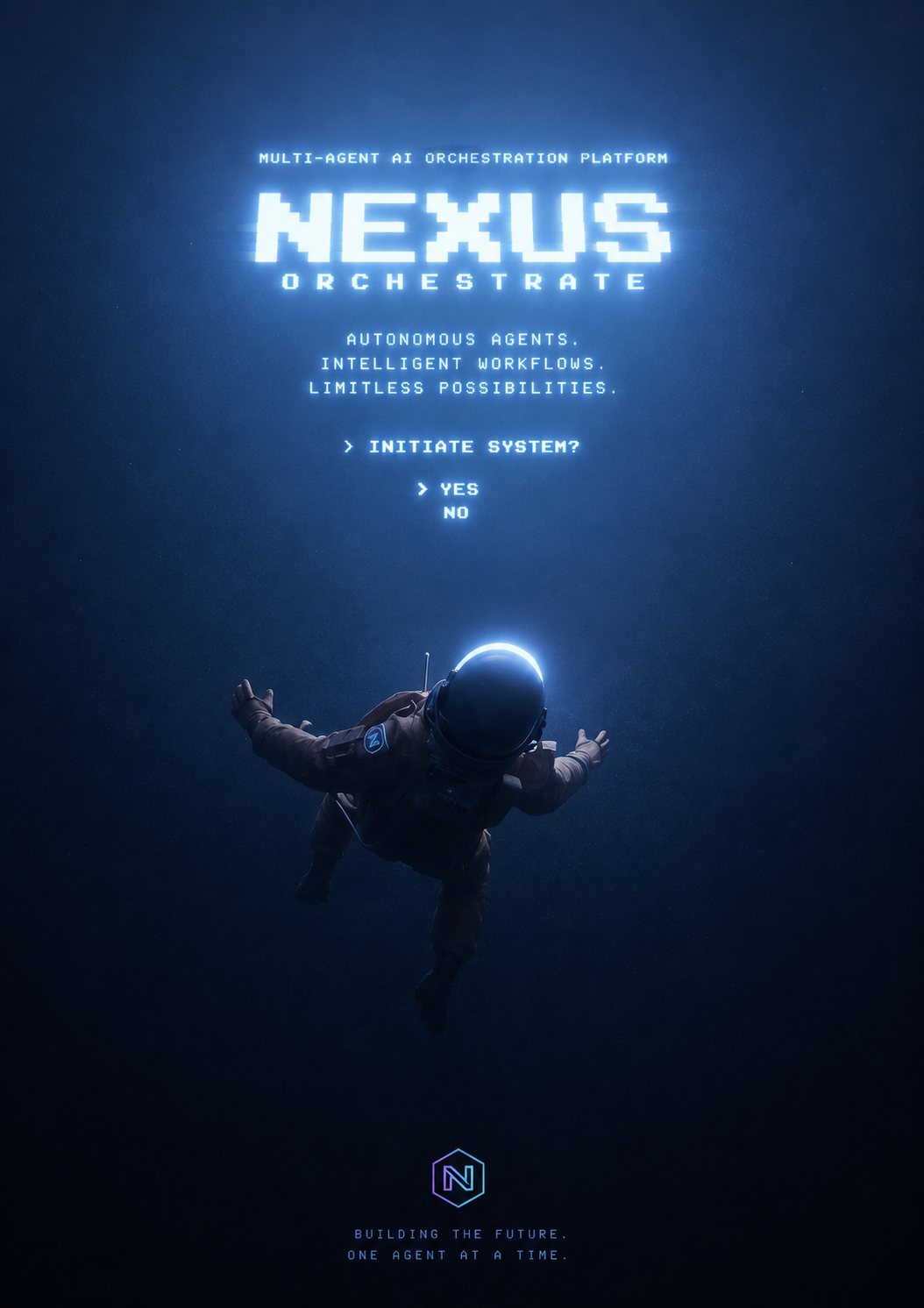
Enterprise-scale multi-agent orchestration system enabling autonomous supervisor agents to delegate tasks to specialized worker agents with long-term vector memory and sandboxed tool execution.
Context
As LLM applications move beyond single-prompt chatbots into autonomous workflows, enterprise environments require multi-agent systems that can break complex goals into sub-tasks, use tools safely, and retain context across sessions.
The Challenge
Single-agent LLMs suffer from context drift, lack deterministic tool sandboxing, and fail when coordinating multiple asynchronous sub-tasks. The architectural challenge was building a resilient, observable multi-agent hierarchy with human-in-the-loop safety gates.
Engineering Process
Hierarchical Supervisor-Worker Topology
Designed an autonomous supervisor agent capable of decomposing user goals into a directed acyclic graph (DAG) of tasks, delegating them to specialized workers (Research, Code Execution, API Integration, Verification).
Long-Term Semantic Vector Memory (RAG)
Implemented a hybrid vector retrieval layer using embeddings and semantic similarity caching, allowing worker agents to retrieve past execution context and enterprise knowledge bases dynamically.
Sandboxed Tool & External API Execution
Created safe execution environments for python code snippets and REST API calls, with parameter validation and strict timeout constraints.
Real-Time Telemetry & Human-in-the-Loop (HITL)
Engineered a WebSocket telemetry stream showing token usage, agent step traces, and state checkpoints, with interactive approval gates for critical actions.
Key Architectural Decisions
ReAct Reasoning Pattern over Naive Tool Calling
ReAct (Reasoning + Acting) enforces an explicit thought trail before executing tool actions, drastically reducing hallucinated parameters and infinite execution loops.
Stateful Graph Execution with Checkpointing
Enabled deterministic replay and pause-and-resume workflows, crucial for human review before write operations or external API calls.
Outcomes & Results
✦ Delivered a multi-agent orchestration pipeline supporting concurrent worker agents with zero-state collision.
✦ Integrated vector memory achieving sub-80ms semantic retrieval across indexed enterprise docs.
✦ Created full end-to-end telemetry tracking execution latency, agent reasoning steps, and token consumption.
Technical Reflection
“Building agentic systems taught me that prompt engineering is only a small slice of AI engineering; robust state machines, sandboxed execution, memory indexing, and observability are what make AI production-ready.”