Case Study · 2024
Data Science & Machine Learning Suite
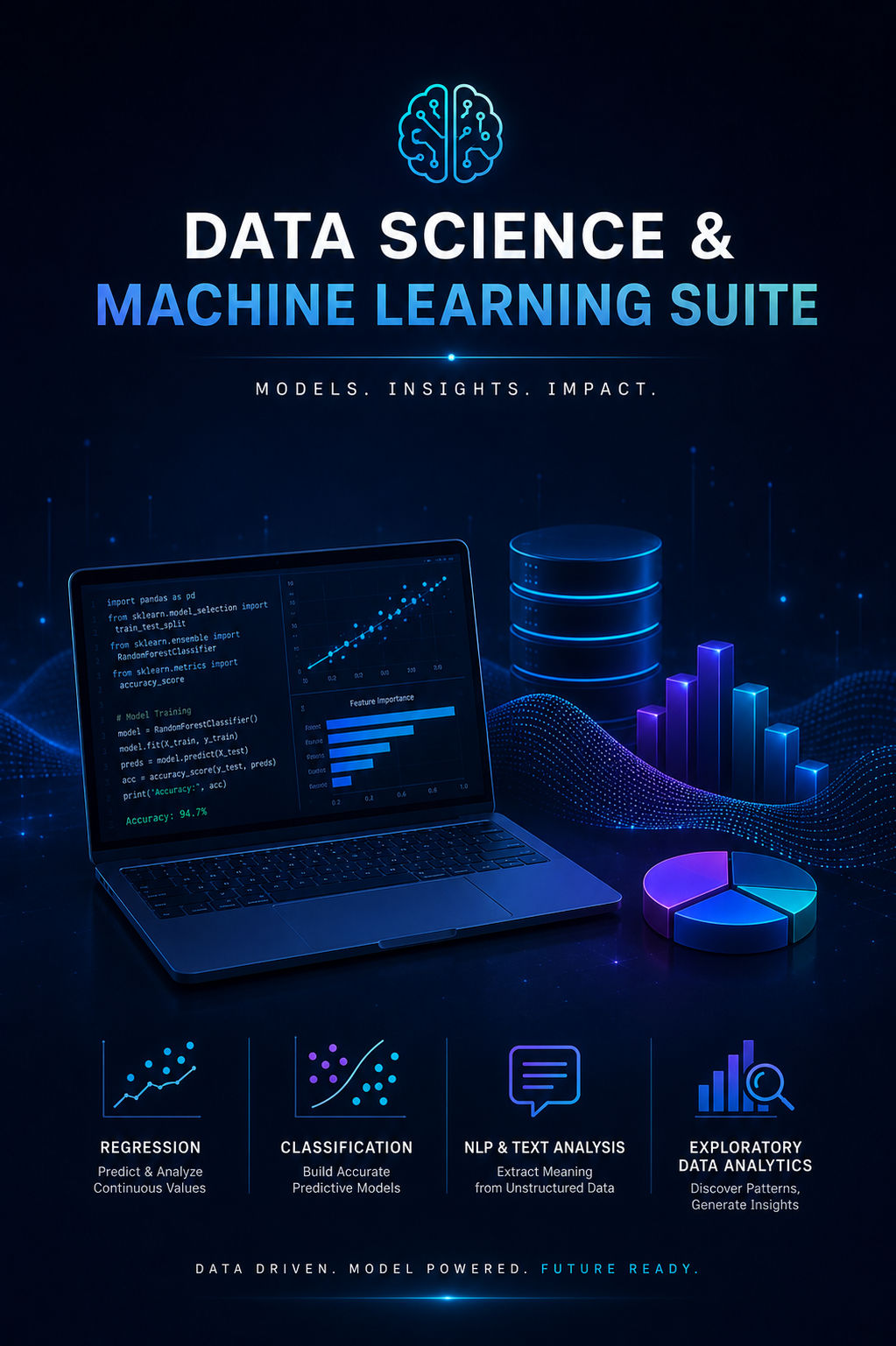
Comprehensive suite of machine learning models and data pipelines covering regression, classification, NLP text analysis, and exploratory data analytics.
Context
Developing robust ML models requires structured exploration across algorithms, cross-validation strategies, and data preprocessing pipelines.
The Challenge
Raw datasets often exhibit severe class imbalance, missing features, and noise that degrade predictive power if not engineered methodically.
Engineering Process
Feature Engineering & Data Cleaning
Engineered automated data preprocessing pipelines handling missing value imputation, one-hot encoding, feature scaling, and outlier removal using Pandas and NumPy.
Regression & Classification Modeling
Trained and benchmarked Linear/Logistic Regression, Random Forests, Decision Trees, and Gradient Boosting algorithms across multiple domains.
Natural Language Processing (NLP)
Applied text vectorization (TF-IDF), sentiment analysis, and tokenization pipelines on unstructured text datasets.
Model Evaluation & Cross-Validation
Validated models using k-fold cross-validation, precision-recall curves, ROC-AUC, confusion matrices, and RMSE metrics.
Key Architectural Decisions
Comprehensive Cross-Validation Pipelines
Prevented data leakage and model overfitting by encapsulating all scaling and transformations inside Scikit-Learn Pipelines.
Modular Script Architecture
Exported trained models via Joblib/Pickle for plug-and-play integration into Flask/FastAPI REST backends.
Outcomes & Results
✦ Created an extensive public repository of machine learning and data analysis projects.
✦ Demonstrated proficiency in data preprocessing, feature engineering, and model validation.
✦ Established the reusable ML model foundations powering subsequent projects like HealthHive.
Technical Reflection
“Deep foundational understanding of machine learning math and validation principles is what allows higher-level GenAI and Agentic architectures to succeed.”